The best biographical movies: 9 films about real lives
Nine of the best biographical movies, from Lawrence of Arabia, Patton and Raging Bull to Gandhi, Amadeus, Malcolm X, A Beautiful Mind, The Social Network and Oppenheimer.
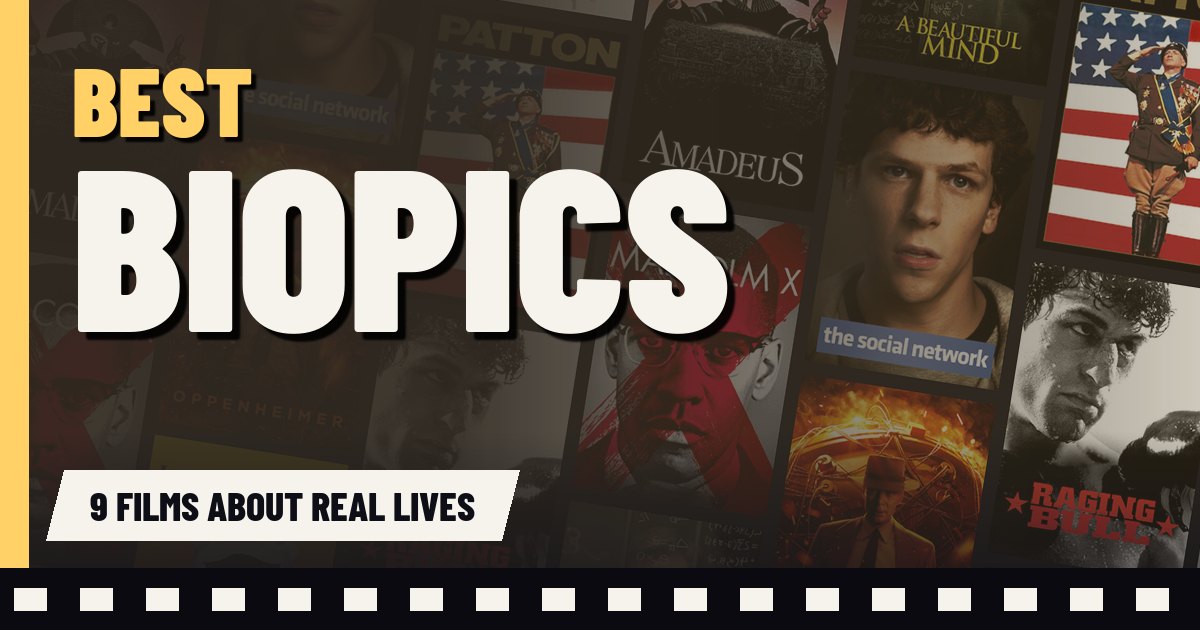
A good biopic turns a real life into a great story. This list gathers nine of the best, in release order, with posters, the director and the lead actor.
Under each poster you will find who the film is about, what it gets right and the awards it won. Six of these nine films won the Oscar for Best Picture, which says a lot about how much Hollywood loves a true story told well.
What makes a great biopic
The weakest biopics try to fit an entire life into two hours, ticking boxes from childhood to deathbed. The best ones choose a moment, a conflict or a single idea and build the film around it. Lawrence of Arabia is about a man losing himself in the desert, Amadeus is about envy and The Social Network is about a lawsuit, yet all three say more about their subjects than any summary could.
Performance matters too. Playing a real person means capturing a voice, a posture and a way of thinking without turning into an impression. Several actors on this list won the Oscar for exactly that.
A great biopic also needs a point of view. Some admire their subjects, others question them, and the most interesting ones do both. The films on this list let us understand why these people mattered while still showing their contradictions, their mistakes and the price they paid.
How we chose
We chose biographical films about real people by critical reception, awards and performances. Biopics often take creative liberties, so this is not a numbered ranking and not a historical record.
We focused on films about real people whose lives had a public impact, in war, politics, art, science, sport or technology. Each film had to be widely praised and still recommended today, not only remembered for one performance.
We also tried to cover different decades of filmmaking, from the grand epics of the 1960s to the fast, dialogue driven dramas of the 2010s. Seen together, they show how the biopic changed from monumental portraits to more personal and critical stories.
Lawrence of Arabia (1962)
Directed by David Lean. Starring Peter O'Toole.
Why it matters: The story of T. E. Lawrence, the British officer who joined the Arab Revolt during the First World War, filmed in the real desert in 70 mm. It won seven Oscars, including Best Picture and Best Director, and made Peter O'Toole a star. Directors like Steven Spielberg have named it one of the films that made them want to make movies.

Watch for the famous cut from a burning match to the desert sunrise, one of the most celebrated edits in film history. The film shows Lawrence as brave and brilliant, but also vain and increasingly lost, which makes him far more interesting than a simple hero.
The film is long, with an intermission, but it rarely feels slow thanks to its landscapes and Maurice Jarre's music. It is ideal for viewers who love epic adventure and want to see how cinema can make history feel enormous.
Patton (1970)
Directed by Franklin J. Schaffner. Starring George C. Scott.
Why it matters: The opening monologue, with George C. Scott as General George S. Patton in front of a giant American flag, is one of the most famous scenes in war cinema. The screenplay was co-written by a young Francis Ford Coppola. The film won seven Oscars, including Best Picture, and Scott won Best Actor and refused the award.

The film presents Patton as a brilliant and difficult man, admired by soldiers and feared by his own superiors. It shows both his military genius and his clashes with discipline and diplomacy, leaving the audience to decide what they think of him.
Patton is a war film with very little sentimentality and a lot of character study. It suits viewers interested in history and leadership, and its opening speech alone has been studied, quoted and parodied for decades.
Raging Bull (1980)
Directed by Martin Scorsese. Starring Robert De Niro.
Why it matters: Shot mostly in black and white, it follows the boxer Jake LaMotta in and out of the ring. Robert De Niro trained as a boxer and gained a lot of weight to play LaMotta in later years, and he won the Oscar for Best Actor. Thelma Schoonmaker won for her editing of the fight scenes, still among the most influential ever filmed.

Scorsese films the boxing matches from inside the ring, with sound and editing that turn each fight into an emotional storm. Outside the ring, the film is a painful study of jealousy and violence at home, which makes it very hard to watch and impossible to forget.
Raging Bull is often named among the best films of its decade and is a central work in the partnership between Scorsese and De Niro. It is not a feel good sports movie, so expect a dark portrait of a man fighting everyone, including himself.
Gandhi (1982)
Directed by Richard Attenborough. Starring Ben Kingsley.
Why it matters: Richard Attenborough spent about two decades trying to get this film about Mohandas Gandhi made. The result covers the struggle for India's independence through nonviolent resistance and won eight Oscars, including Best Picture, Best Director and Best Actor for Ben Kingsley.

Ben Kingsley ages over decades on screen, from young lawyer in South Africa to the leader of a nation. The film focuses on Gandhi's ideas of nonviolence and civil disobedience, and on key moments such as the Salt March, with massive crowd scenes.
Gandhi introduced many viewers around the world to the history of Indian independence. It is long and serious, but very clear, which makes it a good choice for families and students who want an accessible introduction to the subject.
Amadeus (1984)
Directed by Milos Forman. Starring F. Murray Abraham, Tom Hulce.
Why it matters: Based on Peter Shaffer's play, it tells Mozart's story through the eyes of his jealous rival, the composer Antonio Salieri. The film plays freely with history, but its music, costumes and performances won eight Oscars, including Best Picture and Best Actor for F. Murray Abraham, who beat his co-star Tom Hulce.

The film is built as a confession: an old Salieri tells his story and admits his envy of a genius he cannot match. Mozart is shown as childish and brilliant, with a memorable laugh, and the music is used as part of the story.
Amadeus made classical music feel like rock and roll for a new audience. It is entertaining, funny and tragic, and works even for viewers who know nothing about Mozart, which is why it remains one of the most rewatched biopics.
Malcolm X (1992)
Directed by Spike Lee. Starring Denzel Washington.
Why it matters: Based on The Autobiography of Malcolm X, written with Alex Haley, this epic of more than three hours follows Malcolm Little from street hustler to one of the most important voices of the civil rights era. Denzel Washington was nominated for the Oscar for Best Actor, and many critics still consider it his finest performance.

Spike Lee divides the story into chapters that show Malcolm's transformation, from his youth on the streets to prison, faith and political leadership. Denzel Washington captures his voice and intensity in the famous speeches, many recreated with great care.
Malcolm X is essential for anyone interested in the civil rights movement and in how a person can change completely over a lifetime. Its length is a commitment, but the film rewards it with a complex and moving portrait.
A Beautiful Mind (2001)
Directed by Ron Howard. Starring Russell Crowe.
Why it matters: The life of the mathematician John Nash, who won the Nobel Memorial Prize in Economics, and his struggle with schizophrenia. The film simplifies and changes parts of his story, but it won four Oscars, including Best Picture, Best Director and Best Supporting Actress for Jennifer Connelly.

Ron Howard uses visual tricks to put the audience inside Nash's mind, so for a long time we see the world as he does. Russell Crowe shows his brilliance and his isolation, and Jennifer Connelly gives weight to the story of the people who supported him.
A Beautiful Mind is one of the most accessible films on this list, emotional and easy to follow. It is a good choice for viewers who like stories about genius and resilience, as long as they remember that it is a free adaptation of a real life.
The Social Network (2010)
Directed by David Fincher. Starring Jesse Eisenberg.
Why it matters: Aaron Sorkin's rapid-fire screenplay turns the founding of Facebook and the lawsuits that followed into a story about ambition and friendship. It won three Oscars, for the screenplay, the editing and the score by Trent Reznor and Atticus Ross. Armie Hammer played both Winklevoss twins with the help of visual effects.

David Fincher keeps the story moving between two legal depositions and the past, so we see the same events from different sides. The dialogue is fast and sharp, and Jesse Eisenberg plays Zuckerberg as cold, brilliant and lonely at the same time.
The Social Network is often described as one of the defining films about the internet age. It is entertaining even for viewers who do not care about technology, because at its heart it is a story about friendship, betrayal and ambition.
Oppenheimer (2023)
Directed by Christopher Nolan. Starring Cillian Murphy.
Why it matters: Based on the biography American Prometheus, by Kai Bird and Martin J. Sherwin, it follows the physicist J. Robert Oppenheimer from the Manhattan Project to the hearing that took away his security clearance. Nolan recreated the Trinity test with practical effects instead of computer images, and the film won seven Oscars, including Best Picture, Best Director, Best Actor for Cillian Murphy and Best Supporting Actor for Robert Downey Jr.

Nolan alternates color and black and white scenes and moves between different moments of Oppenheimer's life, like a puzzle. The Trinity test sequence, with its silence before the sound arrives, became one of the most talked about scenes of its year.
Oppenheimer was also a huge box office success for a long, dialogue heavy drama. It suits viewers who enjoy history, science and moral questions, and it pairs well with a documentary about the Manhattan Project to separate fact from dramatization.
Where to start
Each of these films fits a different mood:
- A grand epic: Lawrence of Arabia, best on the biggest screen you can find.
- Music and rivalry: Amadeus, as entertaining as it is tragic.
- Sports and self-destruction: Raging Bull.
- Technology and ambition: The Social Network, the fastest paced film on the list.
- History on a huge scale: Gandhi or Oppenheimer.
- A powerful lead performance: Malcolm X.
If you have never watched a classic epic, Lawrence of Arabia and Gandhi are long but very rewarding. For a lighter evening, Amadeus and The Social Network are the most entertaining choices, full of humor and sharp dialogue.
After watching any of these films, it is worth reading a short biography of the real person. Comparing the film with the facts is part of the fun, and it helps you appreciate the choices each director made to turn a life into a story.
Frequently asked questions
What are the best biographical movies?
Among the most praised are Lawrence of Arabia, Raging Bull, Gandhi, Amadeus and The Social Network.
Are biographical movies accurate?
Not always. Biopics compress events, invent dialogue and change details, so they are best seen as interpretations rather than strict history.
Which biopic won the most awards?
Gandhi, Amadeus and Patton were all big winners at the Oscars, among others on this list.
Which biopics won the Oscar for Best Picture?
On this list, six did: Lawrence of Arabia, Patton, Gandhi, Amadeus, A Beautiful Mind and Oppenheimer. Raging Bull and The Social Network were nominated but did not win.
What is the difference between a biopic and a documentary?
A documentary uses real footage, interviews and records. A biopic is a dramatized version with actors, invented dialogue and condensed events, so it tells the truth about a person in a freer, more emotional way.
Rate these movies
Which one is your favorite? On Rankiew you can rate every film, write reviews and build your own lists.
Sources: official studio releases, filmographies and public records.