Horror movies that are really good: 9 essential scares
Nine really good horror movies, from Nosferatu, Psycho and Rosemary's Baby to The Exorcist, Halloween, Alien, The Shining, Get Out and Hereditary, with directors and cast.
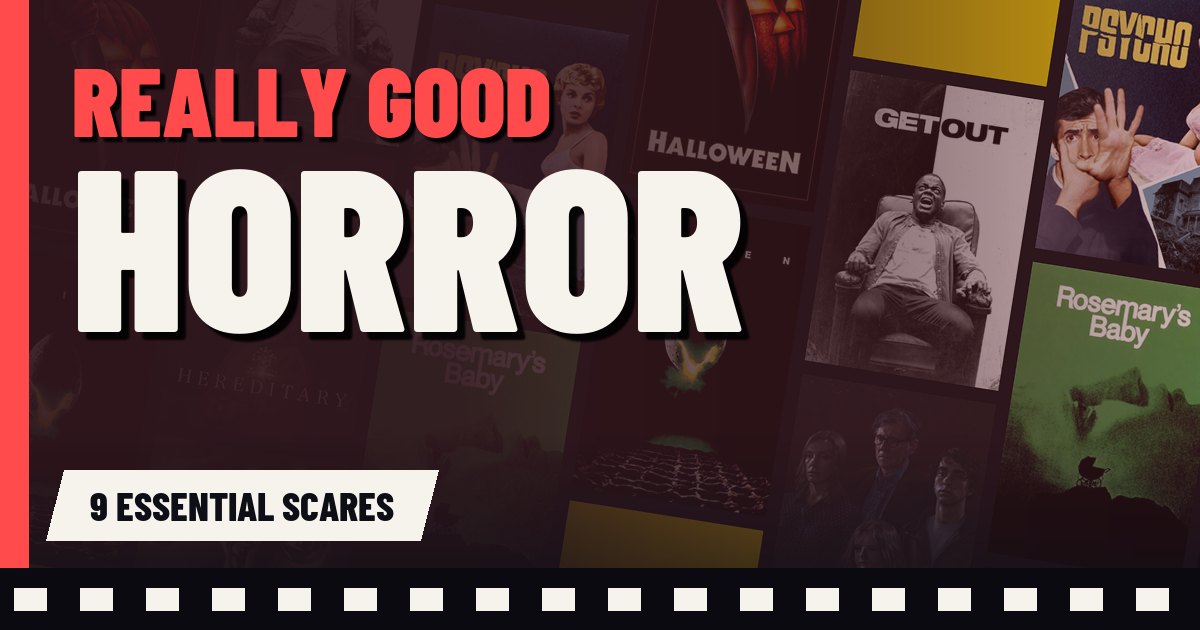
Horror can be art. This list gathers nine of the best horror movies, from silent classics to modern hits, in release order, with posters, the directors and the main cast.
Each title below comes with a short note on why it still matters: the trick it invented, the scene everyone copied or the story behind the camera. Pick one by era, by mood or by how much sleep you are willing to lose tonight.
What makes a horror movie great
Great horror is rarely about the monster alone. It is about what the monster stands for: the stranger at the door, the body that betrays us, the family that turns against us, the house that should be safe. The best horror films also control time. They make the audience wait, and they let sound, silence and the things the camera refuses to show do most of the work.
That is why a silent film from 1922 and a family drama from 2018 can sit on the same list. The tools changed, from shadows on a wall to digital sound design, but the goal is the same: to make you look at the dark corner of the screen and dread what might be there.
Every film on this list also says something about the time it was made. Silent German cinema carried the anxieties of a country after war, the 1970s brought fears about family and faith, and recent horror talks openly about race and grief. Watching them in order is like reading a short history of what scares us.
How we chose
We chose horror films by critical reception, influence on the genre and lasting power to scare, across eras and styles. This is not a numbered ranking, and some films are intense.
We looked for films that changed the genre and are still discussed today, not only films that made money. Each one either introduced a technique, defined a subgenre or showed that horror could win serious critical attention and awards.
We also tried to cover different kinds of fear: the vampire, the killer next door, the possessed child, the creature in space, the haunted hotel and the family curse. If you watch all nine, you will see almost every major branch of horror from the last hundred years.
Nosferatu (1922)
Directed by F. W. Murnau. Starring Max Schreck.
Why it matters: An unauthorized adaptation of Bram Stoker's Dracula, it led to a lawsuit by Stoker's widow, and a court ordered the copies destroyed. Some prints survived, and Max Schreck's bald, rat-like Count Orlok became one of the most imitated images in horror. The shadow climbing the stairs is still a lesson in how to scare with almost nothing.

Watch how Murnau uses real locations, like streets and ships, instead of painted sets. The plague that follows Orlok turns a vampire tale into a story about disease and fear of outsiders, a reading that still feels relevant. The film is short and moves fast for a silent movie.
Nosferatu has been remade and reimagined several times, and its images keep appearing in music videos, cartoons and other horror films. It is the best place to start if you want to see where screen horror began, and it works surprisingly well late at night with the lights off.
Psycho (1960)
Directed by Alfred Hitchcock. Starring Anthony Perkins, Janet Leigh.
Why it matters: Hitchcock shot it in black and white, with the crew of his TV show and a modest budget, and asked theaters not to let anyone in after the film had started. Killing the apparent lead early in the story broke every rule of the time, and the shower scene, cut to Bernard Herrmann's shrieking strings, is one of the most studied sequences in film history.

Pay attention to the first act, which plays like a crime story about stolen money, before the film pulls the rug from under the audience. Anthony Perkins makes Norman Bates polite, nervous and almost likable, which is exactly what makes him frightening. The motel and the house on the hill became iconic sets.
Psycho inspired sequels, a remake and a television series about Norman's youth, and almost every slasher movie owes it something. If you only know the shower scene from parodies, the full film will still surprise you with how carefully it builds suspense.
Rosemary's Baby (1968)
Directed by Roman Polanski. Starring Mia Farrow.
Why it matters: Based on Ira Levin's novel, it moves horror out of castles and into a sunny New York apartment. The fear comes from paranoia: neighbors who are a little too friendly, a husband who is a little too ambitious. Ruth Gordon won the Oscar for Best Supporting Actress as the unforgettable neighbor Minnie Castevet.

Mia Farrow plays Rosemary as fragile but stubborn, and the film stays with her point of view so we never know more than she does. Small details, like a strange smell, a tannis root necklace or a chocolate mousse, slowly become signs of something wrong.
The film showed that horror could be elegant, adult and set in ordinary places, opening the door for The Exorcist and many psychological thrillers. It is ideal for viewers who prefer tension and paranoia to blood, and its final scene is still debated today.
The Exorcist (1973)
Directed by William Friedkin. Starring Ellen Burstyn, Linda Blair.
Why it matters: Adapted by William Peter Blatty from his own novel, it became a cultural event, with long lines and audiences fainting in theaters. It is often cited as the first horror film nominated for the Oscar for Best Picture, and it won two Oscars, for its screenplay and sound.

The film spends a long time on the mother's struggle with doctors and tests before it turns to the supernatural, which makes the horror feel grounded. Ellen Burstyn gives a performance of real desperation, and the special effects and makeup were shocking for audiences of the time.
The Exorcist became one of the highest grossing horror films ever and spawned sequels, a prequel and a television series. Its influence on possession movies is enormous. It is intense and disturbing, so it is best for viewers who already enjoy strong horror.
Halloween (1978)
Directed by John Carpenter. Starring Jamie Lee Curtis, Donald Pleasence.
Why it matters: Made with a tiny independent budget, it set the rules of the slasher film: the holiday setting, the masked killer and the resourceful final girl. Carpenter composed the simple piano theme himself, and the blank mask of Michael Myers was adapted from a cheap store mask. It also launched Jamie Lee Curtis, daughter of Janet Leigh, the star of Psycho.

Carpenter often shows the killer in the background of ordinary suburban streets, in daylight, which makes the danger feel close. The long opening shot from the killer's point of view became a much copied technique. The music, built on a simple repeated pattern, does a lot of the scaring.
Halloween started one of the longest horror franchises, with many sequels and new versions, and Jamie Lee Curtis returned to the role decades later. It is a perfect choice for a group viewing on October nights, scary but not too heavy.
Alien (1979)
Directed by Ridley Scott. Starring Sigourney Weaver.
Why it matters: Sold with the line "In space no one can hear you scream", it is a haunted house movie set on a cargo spaceship. H. R. Giger designed the creature, the film won the Oscar for Best Visual Effects, and Ellen Ripley, a working crew member and not a soldier, became one of the great heroines of cinema.

The first half moves slowly, showing a tired crew doing ordinary work, which makes the chaos later even stronger. The ship's corridors, steam and blinking lights create a world that feels used and real. The chestburster scene is one of the most famous shocks in cinema.
Alien became a franchise with sequels, prequels and crossovers, and James Cameron's Aliens turned it into an action film. The original, though, remains pure horror. It works for science fiction fans as much as for horror fans.
The Shining (1980)
Directed by Stanley Kubrick. Starring Jack Nicholson, Shelley Duvall.
Why it matters: Stephen King famously disliked this version of his novel, but audiences made it a classic. Kubrick used the then new Steadicam to glide behind Danny's tricycle through the empty corridors of the Overlook Hotel, and lines like "Here's Johnny!" are now part of pop culture.

The film builds dread through space and sound: huge empty rooms, endless carpets and a score full of unsettling music. Jack Nicholson's performance goes from tired to terrifying, while Shelley Duvall shows a woman trying to protect her son in an impossible situation.
The Shining inspired endless analysis, documentaries about its hidden meanings and a later sequel, Doctor Sleep. The twins in the hallway and the flood of blood from the elevator are among the most recognizable images in horror. It rewards a second viewing.
Get Out (2017)
Directed by Jordan Peele. Starring Daniel Kaluuya.
Why it matters: Jordan Peele's directorial debut mixes horror and social satire, using the polite smiles of a weekend with the in-laws to talk about racism. Peele won the Oscar for Best Original Screenplay, the first Black screenwriter to win in that category, and "the Sunken Place" entered everyday language.

The tension starts small, with uncomfortable comments and strange behavior from the staff, and keeps growing until the truth comes out. Daniel Kaluuya carries the film with his eyes, and the hypnosis scene is both frightening and full of meaning. There is also a lot of dark humor.
Get Out opened a new wave of horror films with social themes and turned Jordan Peele into one of the most important directors of his generation. It works as a thriller, a satire and a horror film at the same time, which is why it is often used as a first step into modern horror.
Hereditary (2018)
Directed by Ari Aster. Starring Toni Collette.
Why it matters: Ari Aster's first feature starts as a family drama about grief and slowly becomes a nightmare. Toni Collette's performance as a mother falling apart is often named among the great Oscar snubs, and many viewers rank it among the most disturbing films of its decade.

Much of the fear comes from the family itself: silences at dinner, blame and guilt nobody can say out loud. Ari Aster plants clues in the background of almost every scene, from symbols on the walls to the miniature houses built by the mother, an artist.
Hereditary helped define what critics call elevated horror, films that mix drama and fear in a very deliberate way. It is not for everyone, because some scenes are truly shocking, but viewers who like slow, heavy horror often call it unforgettable.
Where to start
Not sure which one to press play on? Use your mood as a guide:
- Classic suspense: Psycho, a perfect first step into horror history.
- A movie night with friends: Halloween, simple, tense and fun to watch in a group.
- Science fiction: Alien, which works just as well as a space adventure.
- A slow burn: Rosemary's Baby or The Shining, for viewers who like dread that builds.
- Something modern and smart: Get Out, then Hereditary if you can handle much heavier fear.
- Film history: Nosferatu, short, silent and easy to find.
If you are new to horror, there is no need to start with the most intense films. Begin with the classics, which build suspense more than shocks, and move to the modern titles once you know what kind of fear you enjoy most.
Another good idea is to watch two films from different eras back to back, like Psycho and Get Out, or Nosferatu and Hereditary. Seeing how the genre changed while keeping the same goal makes each film even more interesting.
Frequently asked questions
What are the best horror movies?
Among the most praised are Psycho, The Exorcist, Alien, The Shining, Halloween, Get Out and Hereditary.
Which horror movie should I watch first?
Start with Psycho for classic suspense, Get Out for smart social horror or Alien for sci-fi terror.
Are old horror movies still scary?
Many are. Films like Nosferatu and Psycho rely on atmosphere and suspense instead of gore, which is why they still work today.
Which horror movie was the first nominated for Best Picture?
The Exorcist (1973) is often cited as the first horror film nominated for the Oscar for Best Picture. Get Out was nominated in the same category decades later.
What is the scariest movie on this list?
It depends on what scares you, but Hereditary and The Exorcist are the two that viewers most often call the most disturbing. Halloween and Alien are tense without being as heavy.
Rate these movies
Which one is your favorite? On Rankiew you can rate every film, write reviews and build your own lists.
Sources: official studio releases, filmographies and public records.